

Press-on nails are meant to make beauty feel easy. So when a set looks slightly off, lifts at the sides, or refuses to sit flat, it can feel surprisingly frustrating. The good news is that a poor fit usually has a simple cause, and in many cases, a very fixable one.
A lot of people assume a sizing problem means the whole set is wrong. Usually, it just means the shape, curve, or width needs a small adjustment. That is part of what makes press-ons so appealing: they offer fresh starts, a sense of grace, and room for individuality, all without locking you into one look.
Fit problems are usually shape problems
Natural nails are not uniform. Some are flatter, some are more curved, some have deep sidewalls, and some flare slightly near the free edge. Press-ons are made to suit a wide range of hands, but no pre-made set will match every nail perfectly straight out of the box.
That is why “doesn’t fit” can mean several different things. A nail may be too wide, too narrow, too curved, too flat, or simply the wrong shape near the cuticle. Once you identify which one you are dealing with, the fix gets much easier.
Here is a simple way to read the problem before you start filing or reapplying.
|
What you see |
What it usually means |
Quick fix |
|
The press-on overlaps skin at the sides |
Too wide |
File the side edges or size down |
|
You can see your natural nail at one or both sides |
Too narrow |
Size up, then refine the edges |
|
The middle touches, but the sides lift |
Too curved |
Warm slightly and press side to side |
|
The sides touch, but the centre lifts |
Too flat |
Use firmer pressure and consider a different size or style |
|
A gap appears near the cuticle |
Cuticle edge mismatch |
Gently file the base to mirror your cuticle line |
Spot the mismatch before you glue
Before you commit to adhesive, place each press-on nails on the nail and look at it from three angles: straight down, side-on, and from the tip back toward the cuticle. That quick check tells you much more than a front-facing glance in the mirror.
A well-fitting press-on nail should sit comfortably from sidewall to sidewall without pinching. It should rest near the cuticle without digging into it. Most of all, it should look balanced from the centre line.
Common signs to look for:
● sidewall overlap
● visible gaps at the edges
● centre lifting
● pressure near the cuticle
● tip leaning left or right
● skin pinching
If a nail feels tight, do not force it. Press-ons should feel secure, not restrictive. A set that pinches on day one rarely improves with wear.
When a nail is too wide
This is one of the easiest issues to fix at home. If a press-on sits over the skin at either side, the answer is often a few careful strokes with a file. A fine-grit file gives the most control and helps keep the edge smooth.
File both sidewalls evenly rather than taking all the width from one side. That keeps the nail shape looking intentional. If you are working with almond, oval, or coffin styles, keep checking the symmetry as you go. Small changes make a big difference.
It also helps to refine the cuticle area at the same time. Sometimes a nail looks too wide because the base is very rounded while your natural cuticle line is flatter, or the reverse. Filing the lower edge into a softer curve can make the whole fit look cleaner.
After filing, dust off the nail and test it again before applying adhesive. Many people skip this re-check and end up over-filing or choosing the wrong size out of habit.
When a nail is too small
A too-small press-on is harder to rescue, but not impossible in some cases. If the nail leaves visible gaps at the sidewalls, the best move is usually to go up one size and file it down. That often gives a neater, more natural finish than trying to stretch or force a narrow nail into place.
This matters even more for long styles. On a short nail, a tiny gap may be less obvious. On a longer style, missing width near the sides can make the whole set look slightly off-balance.
There is one rule worth sticking to: if the press-on exposes the natural nail at the sides, size up. Glue will not hide a width problem, and extra product at the edges tends to look bulky.
A softer shape can help too. If a square style keeps looking narrow at the sidewalls, an oval or almond shape may sit more naturally on the same nail bed.

Curve mismatch is the real troublemaker
Sometimes the width is right, but the curve is wrong. This is where people get confused, because the size seems correct in the box, yet the press-on still lifts or shifts.
If the press-on is more curved than your natural nail, it may touch in the centre while the sides hover. In that case, gentle warming can help. Hold the nail between your fingers for a little while, or warm it slightly with body heat before application. A tiny change in flexibility can help it sit better. The key word here is gentle. You are not trying to bend the nail dramatically.
If the press-on is flatter than your nail, the opposite happens. The sides may sit down while the middle resists. A shorter style often works better on a more curved nail bed because there is less surface area fighting the shape. Choosing a slightly larger size can also help, provided you refine the edges after.
Application pressure matters here as well. Press from the cuticle area forward, then hold firmly through the centre and sidewalls. Done calmly, that can improve contact far more than adding extra glue.
Prep changes the result more than most people expect
A fit issue is not always a sizing issue. Sometimes the nail would have fit beautifully if the natural nail had been prepared properly. Oil, cuticle residue, and moisture can all make a decent fit behave like a bad one.
That is why a quick prep routine earns its place every single time. It does not need to be complicated, but it does need to be consistent.
A few essentials make the biggest difference:
● Surface cleanse: remove oil and residue before applying anything
● Cuticle tidy-up: push back cuticles so the press-on sits against nail, not skin
● Light buffing: take away shine so adhesive grips better
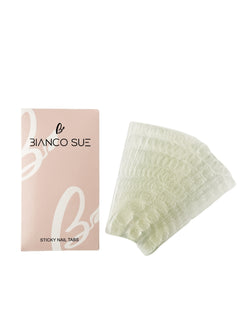
● Adhesive choice: tabs suit short wear, glue suits longer wear
● Firm hold: press each nail for long enough to secure the contact points
If you are between sizes, prep becomes even more important. A near-perfect fit can last beautifully on a well-prepped nail and fail quickly on one that is still oily or damp.
Small customisations make a big difference
One of the best habits with press-ons is to think like a customiser, not just a wearer. A tiny tweak to the cuticle edge, sidewall, or free edge can take a set from “close enough” to polished and convincing.
This is especially useful when your nails differ from finger to finger, which is very common. You may need a different shape correction on your index finger than on your ring finger. That does not mean the set is poor. It means your hands are real.
If you want a cleaner finish, focus on these areas first:
● cuticle line
● sidewall width
● overall length
● free-edge shape
Shortening a nail slightly can solve more than one problem at once. It reduces leverage, improves comfort, and often helps the curve sit more naturally.
A quick routine for testing fit
Trying to troubleshoot mid-application is stressful. A dry fit session before glue keeps things calm and gives you better results.
A simple order works well. Lay out each size, match one to each finger, then check the fit in natural light. Adjust where needed, and place the finished selection in order before you open the glue. It only takes a few minutes, and it prevents that all-too-familiar moment where one hand looks excellent and the other suddenly goes off track.
If you want a practical sequence, use this:
- Match each finger to the nearest size.
- Test from sidewall to sidewall without glue.
- File any nail that overlaps the skin.
- Swap up a size if the natural nail shows at the edges.
- Refine the cuticle edge last.
- Apply adhesive only after every nail has been checked.
That last step matters. Once glue is involved, people rush. Dry fitting first makes the whole process cleaner.
When lifting keeps happening
Repeated lifting usually points to one of three issues: poor prep, curve mismatch, or pressure during application that was too brief. It is rarely random.
If lifting happens at the cuticle, the base may need reshaping. If it happens along the sidewalls, the nail is often too curved, too narrow, or not pressed down long enough. If the whole nail pops off early, the prep or adhesive choice is the first thing to question.
This is also where it helps to be realistic about wear expectations. Adhesive tabs are brilliant for flexibility and quick changes, but they are not meant to behave exactly like glue. If you want a few days of polished wear, glue usually gives the more secure result. If you want an evening look or easy removal, tabs make perfect sense.
Sometimes replacement is smarter than repair
Sometimes, replacement is simply the better option. If a press-on twists, feels tight, or continues to expose the natural nail, choosing a more suitable size or shape will often give a cleaner and more comfortable result.
 Comfort matters just as much as appearance. Well-fitted press-ons should sit naturally on the nail, without pressure at the sidewalls or discomfort near the cuticle. When the fit is right, they tend to feel almost unnoticeable after a short time.
In the end, a little patience goes a long way. Taking a few extra minutes to size, check the curve, and refine the edges can make the difference between a set that feels frustrating and one that wears beautifully.
At Bianco Sue, each design is created with balanced curves and considered proportions, helping press-on nails sit more naturally across different nail shapes while remaining easy to wear in everyday life.